
#HeathersHints · Wedding Etiquette
Who Should Receive a Wedding Invitation?

Somewhere between the engagement announcement and the RSVP deadline, every couple discovers the same uncomfortable truth: the guest list is the first real disagreement of the marriage. Here's the good news. It doesn't have to be. The rules are older than either of your families, considerably more logical than group-text democracy, and once you know them, most decisions make themselves.
The short version
- Invite the household, not the individual. Two people who live together, married or not, receive one invitation and count as one RSVP.
- Anyone invited to a shower, engagement party, or bachelor/bachelorette weekend must be invited to the wedding. No exceptions, except an office shower.
- Plus-ones are earned by relationship status, not by fairness. Married, engaged, and live-in guests are automatic. "Because everyone else got one" is not a rule you owe anyone.
- Never print "no children" or "adults only" on an invitation. The names on the envelope do that work silently and graciously.
Every couple I've worked with in twenty years has asked some version of the same question at eleven at night, calculator open, spreadsheet glaring back: who actually has to be on this list? The honest answer is wonderfully small — closer to a dozen firm rules than the three hundred anxious ones the internet will happily sell you. What follows is the complete list, in the order you'll actually need it.
Start With Concentric Circles, Not a Blank Page
A guest list built from a blank page turns into a popularity contest by the second cup of coffee. A guest list built in circles never does. Draw four rings, smallest first, and fill them in order: the wedding party and immediate family; grandparents, aunts, uncles, and first cousins; the close friends who've been present for the real years, not just the highlight reel; and finally the wider circle — coworkers, casual friends, plus-ones for the not-yet-serious relationships — that expands or contracts entirely based on budget. Stop filling once the budget says stop. The ring you were in the middle of when the money ran out isn't a judgment on anyone in it. It's simply where the math landed, and the math is allowed to be the villain instead of you.
The Household Rule
One rule solves more guest-list arguments than any other, and it's the one couples forget first: invite the household, not the individual. If two adults share an address — married, engaged, or simply committed and cohabiting — they receive a single invitation addressed to both, and both are counted as one household on your response cards. Emily Post's guidance is unambiguous on this point: a guest who is married, engaged, or living with a partner is invited as a couple, full stop. It isn't a favor you're extending. It's the correct address for two people who already share a mailbox.
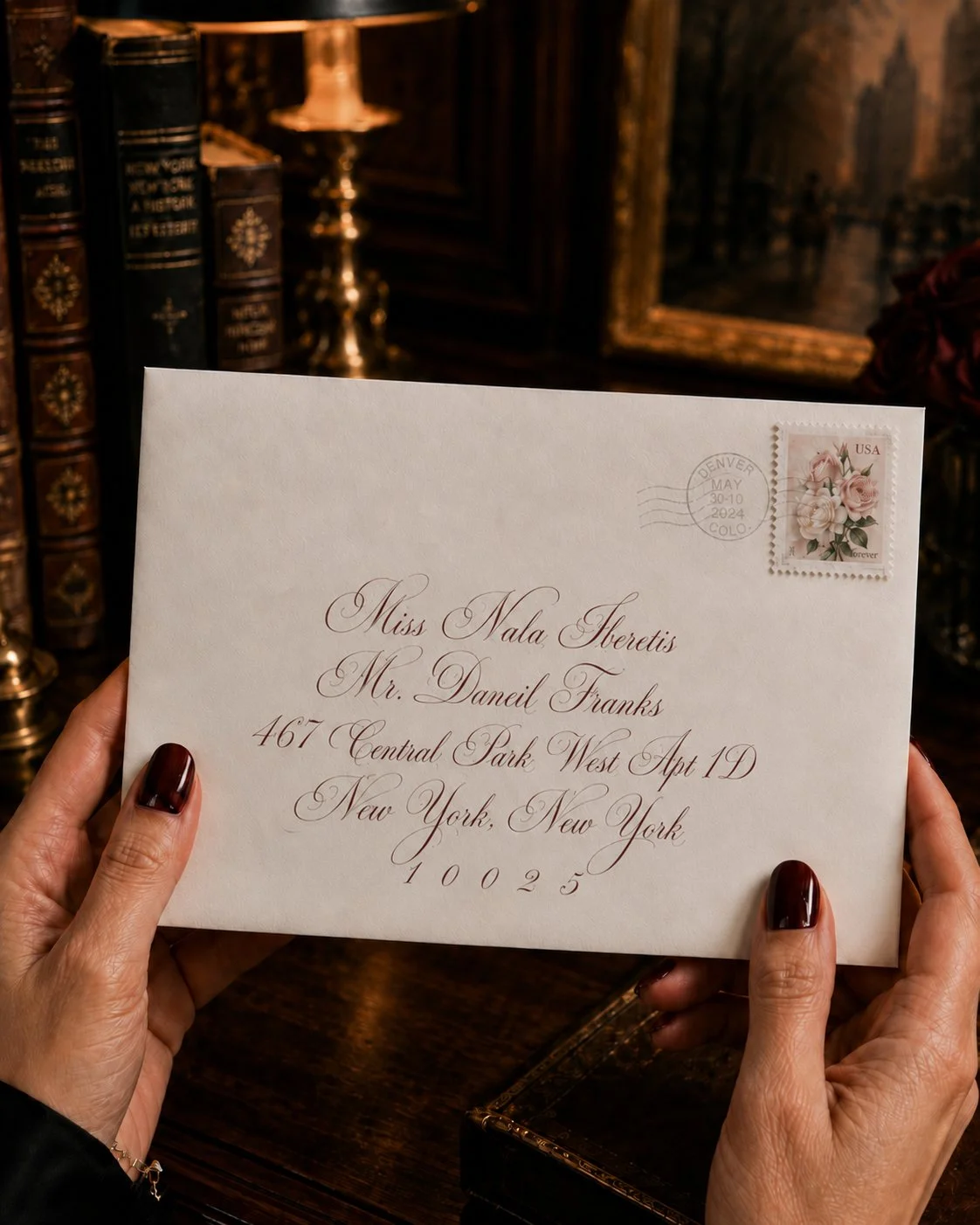
Every name on that envelope is a decision, not a formality. Address it precisely, and the household rule, the plus-one rule, and the child-free rule all take care of themselves — no separate announcement required.
The Rule That Ends Most Arguments
If your fiancé's college roommate had a seat at the engagement party, the shower, and the bachelor weekend, that roommate has a wedding invitation waiting — whether or not you've warmed to them since. Etiquette treats this as a single continuous thread: anyone invited to any pre-wedding celebration must also be invited to the wedding itself, with one narrow exception. Inviting someone to the parties and not the main event isn't a scheduling oversight; it reads as inviting them for the gift, and it is understood exactly that way by everyone who notices. Settle your true guest list before the first shower invitation goes out, even in pencil. It will save you from writing a promise your final list can't keep.
This is precisely why the guest list has to exist earlier than most couples expect. The friend hosting your engagement party or bridal shower will ask for a list of names before you've settled almost anything else about the wedding — often within weeks of the engagement. Whoever goes on that early list is, without anyone quite meaning it, also going on the wedding list. Most couples don't realize the two lists are the same list until the shower invitations have already been mailed, and by then it's too late to reconsider.
Office and workplace showers are the one pre-wedding party that doesn't carry this obligation. A colleague who hosts or attends a desk-side celebration isn't automatically owed a wedding seat because of it.
The rule only binds names that came from the couple's own list. If a shower host adds someone the couple never gave them — a neighbor, a work friend of the host's, a plus-one the host felt bad leaving out — the couple isn't suddenly obligated to seat that person at the wedding. Frankly, the host shouldn't have extended that invitation without asking first. But the guest list belongs to the couple, not to whoever is holding the party, and it stays that way no matter who sends the shower invitations.
Plus-Ones: Who Actually Gets One
The plus-one is the most negotiated line item on any guest list, and also the one with the clearest rule behind it. Anyone married, engaged, or in a live-in relationship is invited as a couple — this isn't up for debate, regardless of whether you've personally met their partner. Beyond that automatic group, three categories earn a plus-one by long tradition: every member of your wedding party, any guest in a serious long-term relationship even without a ring or a shared lease, and any guest who genuinely won't know another soul in the room. "Because my cousin got one" is not on that list, and you're allowed to say so kindly.
The Fair Line, If You Need One
When the venue or the budget forces a hard cut, choose one clear, explainable rule and apply it evenly — for example, only wedding party members may bring an outside guest. A consistent rule, even a strict one, reads as considered. An inconsistent one reads as favoritism, and someone will notice by the following Tuesday.
Children at Weddings: To Invite, or Not to Invite
Whether children are welcome is entirely the couple's decision. There is no etiquette rule requiring you to include them, and none requiring you to exclude them. What etiquette does require is that you never announce the policy directly on the invitation. "No children" or "Adults only," printed on the card itself, is a genuine breach of form — it turns a welcome into an instruction, and instructions don't belong on a card meant to make someone feel chosen.
How to Say It Without Saying It
The address on the envelope does the talking. For an outside validation, Emily Post confirms it. Address it to "Mr. and Mrs. Alan Whitfield," and only Mr. and Mrs. Whitfield are invited — their children, by omission, are not. Address it to "The Whitfield Family," or list every name individually, and every name listed is included. It's a quiet piece of engraved diplomacy, and it is exactly why formal invitations are addressed with such precision in the first place. If a close relative needs the point made plainer, that conversation happens by phone, warmly, days before the invitation arrives — never in print. Better yet, hand the phone to your maid of honor or your wedding planner. That's precisely why they get the big bucks.

Coworkers, Bosses, and the Office Question
The office guest list resolves faster than couples expect once one rule is applied: invite your entire immediate team, or invite none of it. One office bestie — the colleague who's a genuine friend, not just a work friend — is a reasonable, well-understood exception on its own. What isn't reasonable is stretching that exception to a few people and not others: three invited, four visibly not, is one of the fastest ways to sour a Monday morning for years to come, and in a workplace it reads less like an oversight than a judgment call everyone will remember. When in doubt, ask whether the friendship would survive a change of employer. If yes, invite that person as a friend, singular. If the honest answer is no, the wedding isn't the place to test it.
Guests You Don't Actually Owe an Invitation
Obligation is the guest-list killer no one warns you about — the slow creep of names added not because you want them there, but because you feel you should. You don't owe an invitation to a distant relative you haven't spoken to since a childhood holiday, a parent's coworker you've never met, or anyone whose main claim on the list is a gift given once, at a birthday, a decade ago. Etiquette experts are candid on this point: inviting someone well outside your closest circle creates a genuine obligation for them to send a present they may not be able to afford, which is its own quiet unkindness dressed up as generosity. A useful test, borrowed from Emily Post's own guidance: if this person can't attend, would you still want them to know they were thought of? If yes, they belong on the list. If the honest answer is that you were only inviting them to avoid an awkward conversation, that conversation is far cheaper than the seat.
Sometimes the guest you're unsure about isn't a distant acquaintance — it's someone close to you whose presence would complicate your own peace of mind on the day. That's a harder, more personal decision, and it rarely belongs to you alone. It deserves an honest, objective perspective, not someone who tells you what you want to hear just to keep things comfortable. None of this contradicts the fact that the day is entirely about your happiness — it is. Getting there sometimes just takes a candid outside voice. It's one of the situations Heather coaches through most often in her situational-etiquette consultations, precisely because these are milestone decisions with consequences that outlast the wedding day. If this is the knot you're working through, a session with Heather is exactly what it's there for.
| Guest type | Invite? | Why |
|---|---|---|
| Immediate family & wedding party | Always | The inner ring, by definition |
| Anyone invited to a shower or engagement party | Always | The pre-wedding-party rule carries through |
| Married, engaged, or live-in partners of guests | Always, as a household | One address, one couple, one RSVP |
| Casual dating partners of guests | Host's discretion | Not yet a household by etiquette's definition |
| Immediate work team | All or none | A partial list reads as exclusion, not budget |
| Distant relatives not seen in years | Optional | Distance, not blood, is the honest test |
| "Obligation" guests (old gifts, parents' friends) | Skip, gracefully | Creates a gift obligation without a real bond |
Every Name Is a Line Item
Here is the number that ends most guest-list negotiations faster than any etiquette rule ever could: the average American wedding in 2025 hosted 117 guests at roughly $292 per guest, according to The Knot Worldwide's 2026 Real Weddings Study, drawn from more than ten thousand U.S. couples. Meaning every name added to the list is, quite literally, a line item, not merely a sentiment. That's not a reason to be cold about the list. It's a reason to be honest about it. A guest list built from genuine closeness, rather than guilt or habit, tends to arrive — coincidentally — at a number the budget can actually hold. For the fuller picture of where that per-guest figure goes, from paper stock to printing to postage, see our complete guide to How Much Do Custom Wedding Invitations Cost?
What the Research Says About the List You're Actually Capable of Keeping
There's a reason the guest list starts to feel unmanageable somewhere around name one hundred, and it isn't a character flaw. The Oxford anthropologist Robin Dunbar's research on human social networks, since examined further in peer-reviewed studies on relationship stability, puts the number of relationships a person can realistically maintain at a meaningful, stable level at roughly one hundred fifty, tapering down to an innermost circle of only about five truly close relationships. The translation is genuinely useful: if a name on your list took real effort to place, that isn't a lapse in your memory. That's your brain, quite literally, running out of room. It's a very good reason to spend your remaining seats on the fifty people who'd notice if you disappeared, rather than the five hundred who'd simply update their calendar.
The Questions Everyone Googles at 11 p.m.
- Who should be invited to a wedding, at minimum?
- Immediate family, the wedding party, and anyone who was invited to a pre-wedding celebration such as an engagement party, shower, or bachelor or bachelorette event. Beyond that inner circle, the list expands or contracts based on budget.
- Do I have to invite my coworkers to my wedding?
- No, but invite your entire immediate team or none of them. A partial office list is one of the fastest ways to create lasting resentment at work. Colleagues you socialize with entirely outside the office are the one exception, invited as friends rather than as coworkers.
- Is it rude to not give a guest a plus-one?
- No, as long as the rule is applied consistently. Automatic plus-ones go to guests who are married, engaged, or living with a partner, to every member of the wedding party, and to any guest who won't know another soul in the room. Beyond that, a plus-one is a courtesy, not an entitlement.
- How do I word my invitation for a child-free wedding?
- Never print "no children" or "adults only" on the invitation itself. Address the outer and inner envelope with only the names of the adults invited; the omission of children's names communicates the policy without a single unwelcoming word.
- Do I have to invite someone I already invited to my engagement party or shower?
- Yes. Anyone invited to any pre-wedding celebration, with the narrow exception of an office shower, must also be invited to the wedding. Decide your true guest list before the first pre-wedding invitation is sent.
- How many guests does the average wedding have?
- About 117 guests, according to The Knot's 2026 Real Weddings Study of more than 10,000 U.S. couples, at an average cost of roughly $292 per guest.
- What if my budget can't cover everyone on my guest list?
- Cut in full rings, not individual names within a ring. Trim the outer circle — wider family friends, distant coworkers, plus-ones for casual acquaintances — before touching the inner ones, and apply the same standard to everyone in that ring so no one can point to an exception.
write often
The right names deserve the right card. For twenty years, Bell'INVITO has helped hosts build guest lists — and invitation suites — they're proud of.
Just getting started? Begin with our wedding invitation collections or order a sample set. Ready for something entirely your own? Explore the couture & bespoke studio.
Inquire with HeatherHave a guest-list knot I didn't untie? That's exactly the kind of thing I love. Come ask. — H.