
The New Luxury
Why Social Intelligence Is the Ultimate Status Symbol
In a world increasingly shaped by artificial intelligence, automation, and digital communication, one human skill is becoming more valuable—not less.
The Rise of Social Intelligence.
While technology continues to accelerate, the ability to understand people, navigate relationships, communicate thoughtfully, and create positive experiences remains one of the most powerful forms of influence and magnetism.
For decades, luxury has been associated with scarcity, exclusivity, and visible wealth. The people who stand out are often not the loudest, richest, or most connected. They simply understand the scarcity of manners and gratitude, the doors protecting exclusivity that genuine curiosity and self-awareness will often throw open, and that visible wealth is less about the brand worn and more about the style and confidence witnessed.
What Is Social Intelligence?
Social intelligence is the ability to understand social dynamics, interpret interpersonal cues, communicate effectively, and respond appropriately to the emotions, needs, and expectations of others.
Psychologist Daniel Goleman helped popularize the concept through his work on emotional and social intelligence, describing social intelligence as a collection of interpersonal competencies that allow people to build trust, cooperation, and influence. Harvard Business Review has explored the relationship between social intelligence and leadership extensively, noting its importance in effective organizations and relationships.
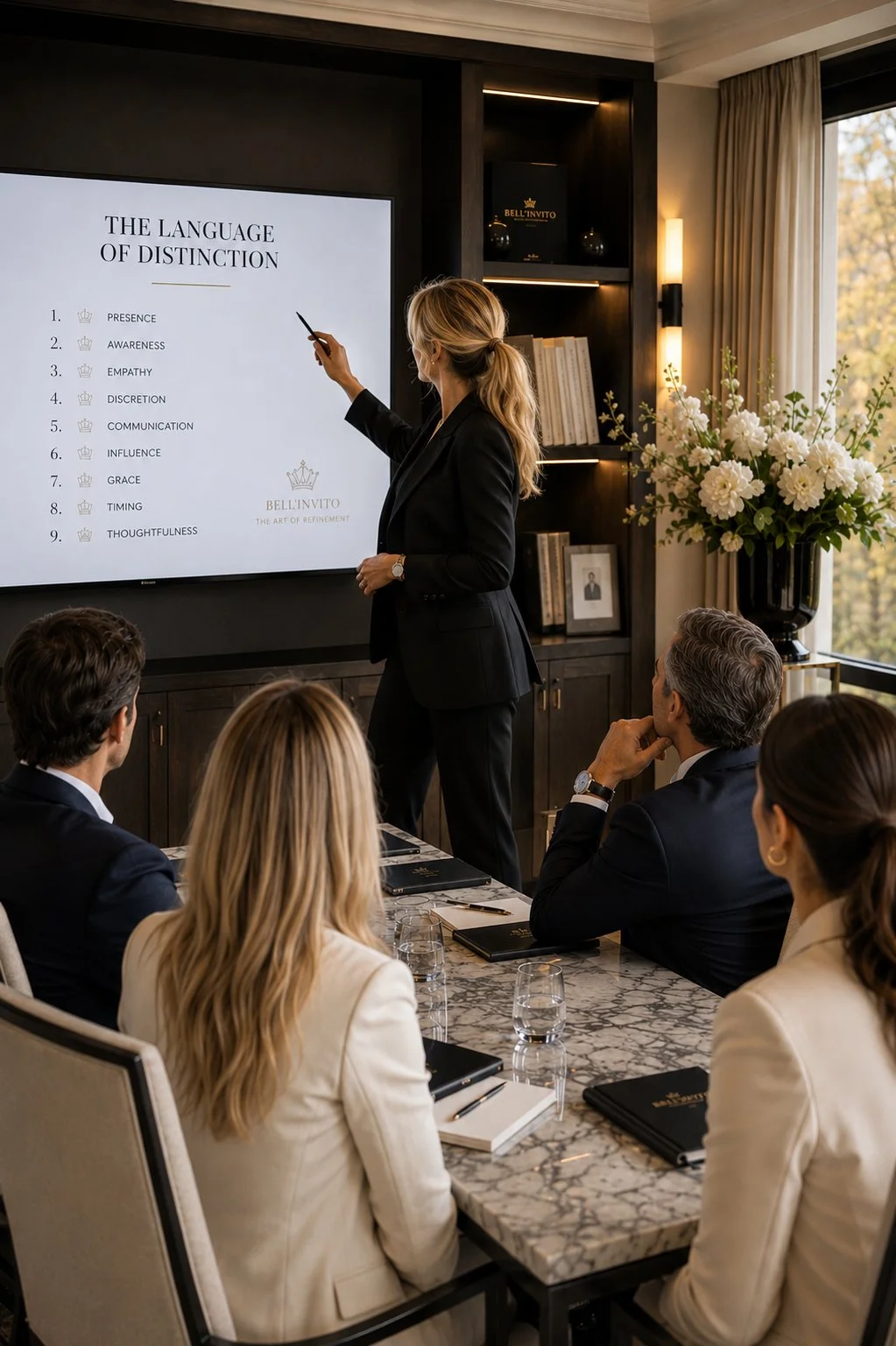
Social intelligence begins with grounded emotional intelligence. After all, you can’t be engaged when the voices in your head are telling you to react emotionally to every trigger. Balancing the emotional stimulation we all feel on varying levels is key. With emotions in-check, there are nine skills that shape your level of social intelligence:
Reading a room: know when to speak, when to listen, when to lead, and when to step aside.
Active listening: Eye contact and appropriate reassurance that you’re engaged without distraction
Empathy: Understand and value others' perspectives.
Self-awareness: Recognize your impact on others.
Timing: Know when something should be said and when it should be shelved.
Diplomacy: Handle sensitive situations with tact and respect.
Adaptability: Adjust to people and circumstances.
Respect for social context: Understand what a situation calls for.
Thoughtful communication: Speak with clarity and consideration.
Every interaction communicates something about who we are. Social Intelligence speaks loudly of your Emotional Intelligence. The terms are often used interchangeably, but they are not identical.
Emotional intelligence is the ability to understand and manage emotions—your own and those of others. Social intelligence expands on that foundation. It is emotional intelligence expressed through behavior. It is not enough to understand people. Social intelligence requires engaging with them skillfully. This is where etiquette plays a role.
Do you remember a name, notice who has been left out of a conversation, know when to offer advice and when to simply listen? These are the hallmarks of social intelligence and modern etiquette. The beauty of an education in both is that many of today's strongest indicators of sophistication cost very little. Whether it is a thoughtful introduction, a handwritten thank-you note, a well-worded invitation, or the ability to make others feel comfortable, valued, and seen, social intelligence remains one of the most accessible forms of luxury.
Is success a motivator for you? Qualities such as thoughtfulness, emotional intelligence, etiquette, and interpersonal grace have become increasingly rare. Research from Harvard Business Review continues to highlight the importance of social intelligence in leadership, influence, and relationship-building.
Why is this Social Intelligence so valuable now?
Without diving into politics, beginning in the 1960s, Western society experienced a series of cultural revolutions that challenged long-standing social norms, institutions, and expectations. Much of that change expanded opportunity, individual freedom, and social mobility. But in the process, many of the informal systems that once passed down lessons in conversation, hospitality, gratitude, correspondence, and social conduct weakened as well.
The result was not the disappearance of good manners, but the disappearance of their consistent instruction.
What was once a commonly taught social language became increasingly optional or completely removed for formal education. A privilege manifested in being taught social skills.
Today, social intelligence, etiquette, hospitality, correspondence, and many aspects of emotional intelligence are often assumed rather than taught. Most people are expected to navigate increasingly complex social and professional environments without ever learning the skills that make those interactions successful.
This is precisely why social intelligence has become such a powerful advantage. In a world where the learned skill of socially interacting intelligently instead of assumptively is increasingly uncommon, the ability exhibit these skills shines brightly due to it’s scarcity.
And like all things that become scarce, they become more valuable.
Perhaps that is the new luxury: not the privilege of ownership, but the privilege of an education in how to navigate the world with confidence, consideration, and social intelligence.
Who recognizes Social Intelligence as a Luxury?
CEOs, progress-leaders, and luxury brands have all recognized this shift and spoken about it often lately. Tatler noted that modern luxury is increasingly defined by meaning, relationships, social value, and human connection rather than visible displays of wealth alone. Vogue is talking about deliberate, direct brand connection with their clients. They understand that how a person feels directly impacts their success.
The socially intelligent person understands that every interaction leaves an impression. They recognize that how something is communicated is often just as important as what is communicated.
The finest hotels anticipate needs before they are voiced. Exceptional hosts make guests feel effortlessly welcome. The most admired brands understand that details matter. Luxury, at its highest form, is consideration. It is thoughtful. Intentional. Memorable.
As technology continues to reshape how we work and connect, social intelligence and the fine details of etiquette, are becoming increasingly important and valued.
The ability to make people feel respected, understood, and appreciated cannot be automated. It cannot be outsourced. It cannot be replicated by a logo, a title, or a balance sheet. That is why social intelligence has become the ultimate status symbol.
Not because it signals wealth. Because it signals character.
In a world where attention is fragmented, patience is scarce, and gratitude is often overlooked, the person who possesses genuine social intelligence stands apart.
The new luxury is not what you own. It is how you make people feel.
Thank you for joining me in this quick read. I appreciate you. I wish you the luxury and effortless fulfillment of living beautifully every day!
xx,
Heather Wiese
Who Books a Session with Heather?
Executives preparing for the next level. Entrepreneurs building relationships. Young professionals learning skills rarely taught in school. Parents investing in a young adult's confidence. Engaged couples preparing to host with grace and navigate wedding etiquette with ease.
At every stage of life, social intelligence creates opportunities, strengthens relationships, and builds confidence. Heather's coaching helps clients develop the skills that make others feel comfortable, respected, and valued—qualities that never go out of style.