
#HeathersHints · Fine Printing
What Is Engraving? How the Oldest Luxury Print Method Works
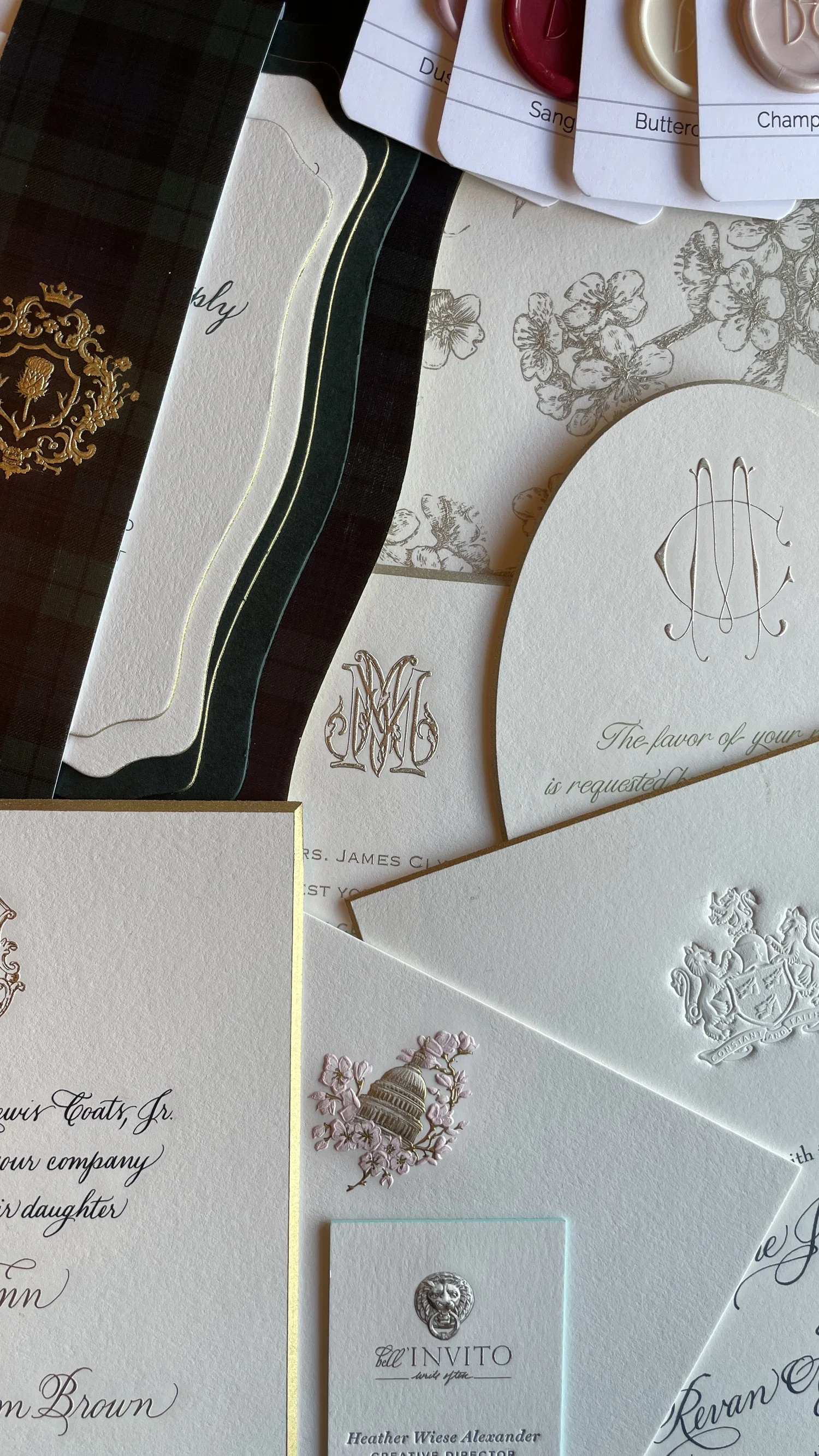
Engraving is a printing method in which the design is cut into a metal die, ink is trapped in the cut lines, and paper is pressed into the die with about two tons of pressure per square inch. The paper pulls the ink out of the lines, so the type stands up from the sheet, crisp enough to read with a fingertip. On the back, each letter leaves a faint dent called a bruise. That bruise is how you know it's real.
The short version
- Engraving is intaglio printing. Ink sits in the recessed lines of a metal die, not on top of a raised surface.
- The result is raised ink on the front and a bruise, a faint indentation, on the back.
- Thermography is the imitation. Melted resin makes ordinary ink puff up. It's often shiny, and the back is smooth.
- Letterpress is the opposite. It presses ink into the paper; engraving lifts it above.
- One die and one press pass per ink color, one sheet at a time. That's where the cost and the time go.
- Engraving's strengths: hairline detail, fine script, and opaque ink, even white on black.
How Engraving Works, Step by Step
Engraving belongs to the intaglio family of printmaking, from the Italian intagliare, to carve. The Metropolitan Museum of Art defines it simply: lines are cut into a metal plate "in order to hold the ink" (The Met). Everything else is technique.
| Step | What happens | Why it matters |
|---|---|---|
| 1. Artwork | The design is finished in black and white, one file per ink color. | Every color will become its own die. |
| 2. The die | The design is cut or etched, in reverse, into a thick steel or copper die. | The depth of the cut decides how high the ink will stand. |
| 3. The counter | A shaped backing is made to match the die. | It pushes the paper up into the lines and sculpts the raised letters. |
| 4. Inking and wiping | Ink is flooded across the die, then wiped from the surface. | Ink stays only in the recessed lines. A clean wipe means clean edges. |
| 5. The impression | Each sheet is pressed into the die under roughly two tons per square inch. | The paper lifts the ink out of the lines and takes their shape. |
| 6. Drying, then the next color | Sheets dry before the next die goes on. The press is cleaned and re-inked for each color. | A three-color crest is three separate runs. |
The pressure figure and the one-color-per-pass rule both come from the trade's own reference, Nancy Sharon Collins's glossary for The Complete Engraver (PRINT). The rest comes from the press room. Engraving rewards patience and punishes shortcuts, a little like making a soufflé, except the soufflé is your wedding invitation and there are two hundred of them.
The Vocabulary of Engraving
You'll hear these words from any serious engraver. Knowing them makes you a better client, and occasionally a more intimidating one.
| Term | Meaning |
|---|---|
| Intaglio | Any printing in which ink is held in recessed lines. Engraving and etching are both intaglio. |
| Die | The thick metal block, usually steel, into which the design is cut. PRINT puts today's norm at about half an inch thick. |
| Plate | A thinner engraved metal sheet, about 16 gauge, used for some commercial engraving. |
| Counter | The shaped backing behind the paper that helps raise the image and keeps ink from spitting. |
| Bruise | The faint indentation on the back of the sheet behind every engraved line. The signature of real engraving. |
| Die stamping | Engraving printed from a die on a die-stamping press; the term most engravers use for stationery. |
| Blind embossing | A die pressed into paper with no ink, leaving a raised, colorless design. |
| Copperplate | The flowing script named for the engraved copper plates of old writing manuals. |
| Thermography | Raised printing made with heat and resin powder, invented to look like engraving at a lower price. |
Engraving vs. Thermography: How to Tell the Difference
Engraving and thermography both produce raised ink. Only one of them shapes the paper. Thermography begins as ordinary flat printing. While the ink is still wet, it's dusted with plastic resin powder, the excess is vacuumed away, and the sheet passes through an oven so the powder melts and swells (overview of the process). PRINT's glossary is blunt about its purpose: "raised printing invented to look like engraving at a lower price," and it notes that "thermography has no bruise" (PRINT).
| Test | Engraving | Thermography |
|---|---|---|
| Turn it over | A bruise behind every line | Perfectly smooth |
| Run your thumb across | Crisp, sculpted ridges | Rounded, slightly rubbery bumps |
| Tilt it to the light | Matte or soft satin | Often glossy, almost plastic |
| Look at fine lines | Sharp, even at tiny sizes | Can blur or fill in as the resin swells |
| Light ink on dark paper | Opaque and clean | Limited |
| Paper | Often heavy cotton, shaped by the die | Any paper that survives the oven |
| Cost and time | Higher; a die per color, slow press | Lower; no die, fast |
Thermography isn't a fraud. It's a reasonable product at its own price. The trouble starts only when it's sold as "raised printing" to someone who believes they're buying engraving. The test takes two seconds: turn the card over. No bruise, no engraving.
Anything can be raised. Only engraving leaves a bruise.
Heather Wiese · Bell'INVITOEngraving vs. Letterpress, Foil, Embossing, and Digital
Every fine printing method has a job it does best. Engraving's job is detail and formality.
| Method | How the ink sits | What you feel | Best for |
|---|---|---|---|
| Engraving | Raised above the paper | Crisp ridges on the front; a bruise on the back | Script, monograms, fine lines, light ink on dark paper |
| Letterpress | Pressed into the paper | A soft dent you can trace | Bold type, modern designs, a deep impression |
| Foil stamping | Metallic film heat-pressed onto the surface | Smooth shine, a slight impression | Mirror-bright gold, silver, and copper |
| Blind embossing | No ink at all | A raised, colorless design | Monograms, crests, borders |
| Thermography | Resin raised on top of flat ink | Smooth, rounded bumps; flat back | Raised look on a tighter budget |
| Digital | Flat on the surface | Nothing | Photographs, watercolor, many colors |
Letterpress and engraving are the two methods people confuse most, and they're mirror images. For the full side-by-side, read engraved vs. letterpress wedding invitations.
A Short History of Engraving
European printmakers were cutting copper plates with a steel tool called a burin by the fifteenth century, within a generation of Gutenberg's press. For four hundred years, engraving was how the world reproduced fine detail: maps, scientific plates, music, portraits, and the writing manuals whose looping hand we still call copperplate. Calling cards, wedding invitations, and letterheads followed, and engraving became the standard for formal social correspondence. Steel dies, more durable than copper, arrived in the early twentieth century (PRINT).
The best proof of engraving's precision is in your wallet. U.S. paper currency is printed by intaglio. The Bureau of Engraving and Printing presses paper onto engraved plates "under great pressure," on presses that print with up to 20 tons of force, and says the dried ink "feels like fine sandpaper" (Bureau of Engraving and Printing). Governments choose intaglio for the same reason brides do. It is very difficult to fake.
What Engraving Does Better Than Anything Else
Hairline detail
Because the design is cut into metal, engraving holds the thinnest strokes of a script, tiny capitals, and fine borders without filling in. A monogram at half an inch keeps every flourish.
Opaque ink
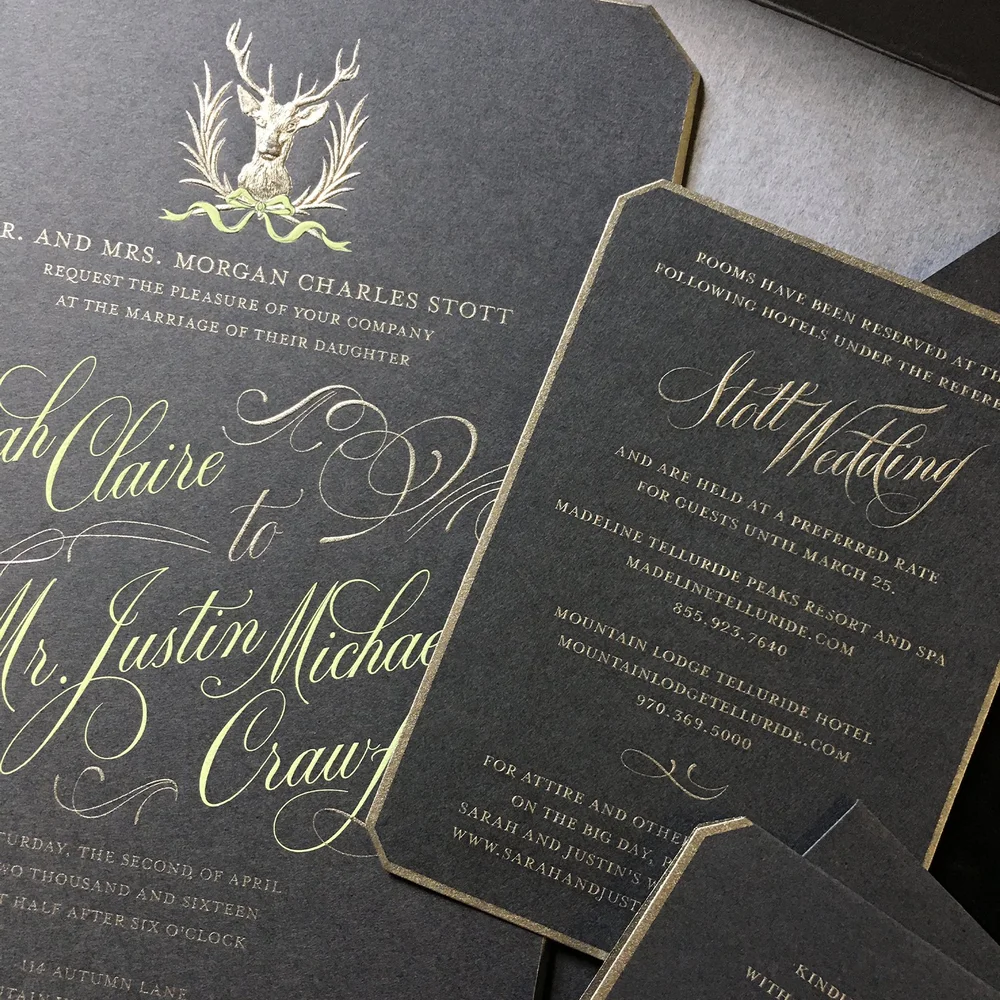
Engraving inks sit on top of the paper rather than soaking in. White on navy, gold on black, and pale gray on deep green all print cleanly, with no paper color showing through.
A sculpted surface
The paper itself takes the shape of the letters. It's the only method that changes both sides of the sheet, which is why guests turn engraved cards over without being told to.
Where engraving is the wrong tool
Engraving is a line method. It isn't suited to photographs, watercolor, large solid blocks of color, or designs that need many colors. Engraved areas are also limited in size by the die, so a design that runs edge to edge usually belongs to another method, or to a mix of methods.
Where Engraving Is Used Today
Social stationery
- Formal wedding invitations and reply cards
- Monogrammed correspondence cards and letter sheets
- Calling cards and gift enclosures
- Engraved holiday cards
Business and ceremony
- Letterheads and business cards
- Diplomas, certificates, and commissions
- Formal announcements and invitations of state
- Currency and securities
For weddings, engraving is still the traditional choice for black-tie and religious ceremonies, and it pairs naturally with formal wedding invitation wording. If you're deciding whether to engrave yours, read engraved wedding invitations: what makes them worth it. For everyday correspondence, an engraved monogram is the most efficient luxury there is: the die is made once and prints for decades.
If you're engraving a monogram or crest for one occasion, ask us to keep the die on file. The next order skips the most expensive step.
What Engraving Costs, and How Long It Takes
| Cost driver | Why |
|---|---|
| Dies | Every design is cut into its own metal die before anything prints. |
| Ink colors | Each color needs its own die, its own press run, and a cleanup. |
| Paper | Heavy cotton papers take engraving beautifully and cost more. |
| Quantity | Setup costs the same for fifty or five hundred, so the price per piece falls as quantity rises. |
At Bell'INVITO, engraved pieces ship three to four weeks after proof approval, and engraving can't be meaningfully rushed. You can personalize an engraved design from our Bespoke collection at the price shown online, with no minimum. A Completely Custom engraved suite, designed from a blank page, typically runs $5,000 to $20,000 or more. For wedding budgets in detail, see how much custom wedding invitations cost.
Engraving: Frequently Asked Questions
- What is engraved printing?
- An intaglio method: ink is trapped in lines cut into a metal die, and paper is pressed into the die under about two tons per square inch. The result is raised ink on the front and a bruise on the back.
- What is the difference between engraving and thermography?
- Engraving shapes the paper with an inked metal die. Thermography melts resin powder on flat ink so it puffs up. Thermography imitates engraving for less; it's often glossy and leaves the back smooth.
- How can you tell if something is engraved?
- Turn it over. A bruise behind every line means engraving. A smooth back means it isn't.
- Is engraving the same as die stamping?
- Essentially, yes. Die stamping is the trade name for engraving from a die on a die-stamping press. A die pressed without ink is blind embossing.
- Is engraving the same as letterpress?
- No. Letterpress presses inked raised surfaces into the paper, leaving a dent. Engraving presses paper into inked recessed lines, leaving raised ink.
- Why is engraving expensive?
- A die for every design, a die and press run for every color, and one sheet at a time. Setup costs the same at any quantity.
- Is money engraved?
- Yes. U.S. currency is printed by intaglio, and the Bureau of Engraving and Printing says the dried ink feels like fine sandpaper.
- Can engraving print white ink on dark paper?
- Yes. Engraving inks are opaque, so white, pale, and metallic inks print cleanly on dark papers.
- How long does engraving take?
- At Bell'INVITO, three to four weeks after proof approval. It can't be meaningfully rushed.
write often
Engraving is the slowest way to put words on paper, and the one people keep. For twenty years, Bell'INVITO has engraved the invitations and stationery that end up framed, not filed.
Personalize an engraved design from our Bespoke collection, priced as shown online with no minimum, or commission a Completely Custom engraved suite, typically $5,000 to $20,000+, designed from a blank page.
Explore Wedding InvitationsHolding a card and wondering whether it's really engraved? Turn it over, then call the studio at 214.676.5776 and tell me what you see. — H.